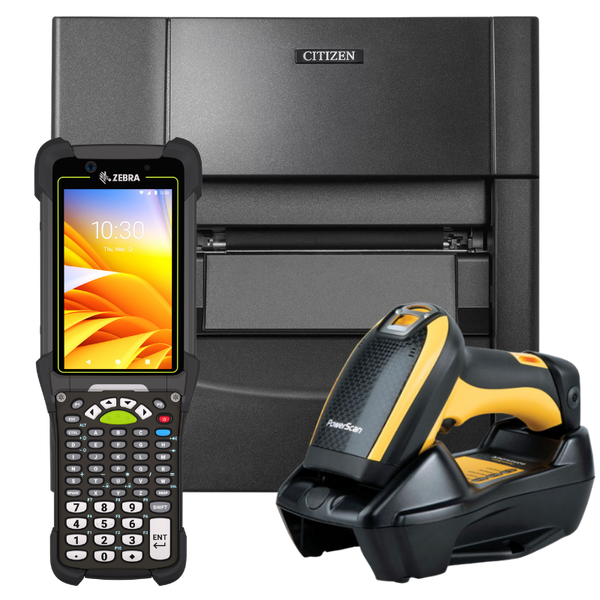
Manufacturing Hardware

Marking, Scanning and Traceability on the Plant Floor

Industrial label printers, DPM-capable scanners, rugged mobile computers and media rated for heat, solvents and oil. Specified so the mark survives your process and still reads at audit.

DPM Scanning for Etched Part MarksPolyimide and Polyester MediaIndustrial Printers for Continuous DutyOn-Metal RFID for Tooling
Marking, Scanning and Traceability on the Plant Floor

Traceability Is Only as Good as the Mark

Manufacturing traceability is a chain, and it breaks at whichever link is weakest. A serialised part can be traced back to its batch, its machine and its operator, but only if the identifier applied at the start survives everything the process does to it afterwards.

That is what makes manufacturing hardware different. In most industries a label has to survive handling. Here it may have to survive a reflow oven, a paint booth, a solvent wash or years of oil and swarf, and still be readable at audit. Get the media wrong and the traceability exists on paper but not on the part.

Reading is the other half. Direct part marks are etched into the material with no contrast and no quiet zone, and a standard imager simply will not decode them. That is a distinct scan engine chosen at purchase, not something that can be enabled later.

Specify the label against the harshest process it will meet, not the average one. The mark has to outlive the process.

Traceability Is Only as Good as the Mark
Serial Traceability starts at the part

A serialised part can be traced to its batch, machine and operator. Without a durable mark applied at source, that chain never exists.

DPM Direct part marks

Dot-peened and laser-etched codes have no contrast and no quiet zone. A standard imager cannot read them; a DPM engine is a separate specification.

300°C Polyimide label survival

Labels going through reflow, paint or powder coat need polyimide. Paper and polyester char or melt long before the process finishes.

24/7 Continuous line duty

Industrial printers are rated for continuous shift printing. A desktop printer on a production line fails in months, not years.

Questions Before You Specify

Manufacturing hardware is bought against a process that will still be running in five years. These are the questions worth settling first.

01

What POS Software Will It Run?

Start here, because the software decides nearly everything else. Cloud and tablet platforms usually expect Android or iPadOS and publish a short list of approved printers. Established retail and restaurant packages tend to expect Windows and a wider set of ports. Get the vendor's supported hardware list before pricing anything.

03

What Are the Worst Conditions in the Building?

Specify against the freezer aisle and the loading dock, not the office. Cold storage needs heated windows and low-temperature batteries. Dusty or wet areas need a sealed IP rating. If any of the work happens below freezing, the label adhesive has to change too, because standard adhesive releases on chilled goods.

05

How Long Do the Labels Need to Last?

Direct thermal is cheaper to run because there is no ribbon, but it fades with heat, light and abrasion. Anything that must stay readable for months, or that will sit in a freezer or outdoors, needs thermal transfer with a matched ribbon. Print method is fixed at manufacture, so it is a purchase decision rather than a setting.

06

How Many Operators, and How Many Sites?

Equipping one workflow is a purchase; equipping a building is a standard. Once several operators carry the same device, spares, batteries and chargers should interchange, which argues for one model rather than the cheapest option each time. Across multiple sites, staged delivery and pre-configuration matter as much as the hardware itself.

Test the Media Against Your Process

Send us your process temperatures, chemistry and marking standard, and we will specify media and hardware against it. Where the requirement is unusual, we would rather run a sample through your line than guess from a datasheet.

Talk to a Specialist

Hardware by Manufacturing Workflow

From goods-in to dispatch, each stage adds to the traceability record. The hardware question at every stage is the same: will the mark survive what happens next, and can it still be read.

Workflow What It Involves Hardware Needed Key Consideration Shop
01Goods In and Raw Material

Booking in raw material and components, recording batch and lot numbers, and labelling stock for the store.

  • Rugged mobile computer
  • Industrial label printer
  • Batch label stock

Batch and lot capture at goods-in is what makes downstream traceability possible. If it is keyed by hand here, no amount of scanning later recovers the link.

02Work in Progress

Tracking parts and assemblies between operations, recording which machine and operator handled each stage.

  • Fixed-mount or wearable scanner
  • Line-side label printer
  • Heat-resistant labels

Labels travelling with WIP go wherever the part goes. If any stage involves an oven, paint booth or solvent wash, the label has to survive it or identity is lost mid-process.

03Part Marking and Serialisation

Applying a permanent unique identifier to the part itself, and verifying it can be read reliably afterwards.

  • DPM-capable scanner
  • Polyimide or polyester labels
  • Industrial printer

Direct part marks are etched into the material with no contrast and no quiet zone. Reading them needs a DPM scan engine, which is a distinct part number rather than a setting on a standard imager.

04Quality and Inspection

Recording inspection results against a serialised part, flagging non-conformance and holding stock.

  • Mobile computer or tablet
  • Handheld scanner
  • Hold and reject labels

Reject and hold labels need to be visually unmistakable and hard to remove accidentally. Colour-coded stock and a strong adhesive matter more than print resolution here.

05Finished Goods and Dispatch

Packing, labelling to customer specification and producing the compliance documentation that ships with the order.

  • Industrial label printer
  • Verification scanner
  • Carrier and compliance labels

Automotive and aerospace customers specify label format and print quality contractually. Verify against the standard rather than by eye, because a rejected shipment costs far more than the verification scanner.

06Maintenance and Tooling

Tracking tools, jigs, fixtures and calibrated equipment, and recording service and calibration intervals.

  • Asset labels or RFID tags
  • Handheld reader
  • Mobile printer

Tool and fixture labels live in oil and swarf. On-metal RFID tags read where a barcode would be unreadable within weeks, and are worth the cost on anything calibrated.

Start where the traceability chain currently breaks. That is usually goods-in, where batch numbers get keyed by hand, or a process stage where labels do not survive and identity is reapplied from memory.

Discuss Your Process

What Actually Breaks Plant Floor Hardware

A production environment attacks hardware and media in ways an office or warehouse never does, and most of the defences have to be specified at purchase.

Direct Part Marks

What happens

Dot-peened, laser-etched and chemically etched codes are marked into the material itself. They have almost no contrast, often no quiet zone, and sit on curved or reflective surfaces. A standard imager will not decode them.

What to specify Specify a DPM-capable scan engine with the right illumination. This is a distinct engine, not a firmware setting, and it has to be chosen at purchase.
  • dpm
  • 2d

Heat, Solvents and Coatings

What happens

Labels that pass through reflow ovens, paint booths, powder coating or solvent wash will char, lift or dissolve if the facestock and adhesive are not rated for the process.

What to specify Polyimide for high heat, acrylic or polyester for chemical exposure. Match the label to the highest temperature and harshest chemistry it will meet, not the average.
  • polyimide
  • acrylic
  • polyester

Oil, Coolant and Swarf

What happens

Machine shops coat everything in cutting fluid and metal dust. Unsealed devices ingest it, scan windows film over, and labels lose adhesion on oily surfaces.

What to specify Sealed IP-rated housings and scan windows that can be wiped clean. For labels, surface preparation matters as much as adhesive choice on contaminated substrates.
  • rugged
  • ip65

Vibration and Line-Side Mounting

What happens

Hardware mounted to a machine or conveyor takes constant vibration. Connectors work loose, mounts fatigue, and a fixed scanner drifts out of alignment until it stops reading.

What to specify Industrial mounting hardware and locking connectors, plus a periodic alignment check on any fixed-mount scanner. Consumer mounts are not rated for continuous vibration.
  • fixed mount
  • industrial

Gloves and PPE

What happens

Operators wear cut-resistant or chemical gloves and often eye protection. Touchscreens ignore the gloves, and small on-screen targets are hard to hit accurately through safety glasses.

What to specify Glove-capable touch or physical keys, and larger touch targets. Where operators cannot use a screen at all, a wearable scanner with audible or haptic confirmation works better.
  • resistive
  • keypad
  • wearable

Marking Standards and Audit

What happens

Automotive, aerospace, medical device and defence supply chains specify how parts must be marked and how legible the mark must remain. A mark that degrades fails audit even if the part is perfect.

What to specify Verify print and mark quality against the applicable standard rather than by eye, and keep the media specification documented so it can be reproduced years later.
  • industrial
  • polyimide

Test media against your actual process before committing. A label that passes a datasheet temperature rating can still fail in your specific oven, chemistry or cycle time.

Check Your Requirements

Complete Manufacturing Systems

The printer, the media and the scanner have to agree with each other and with your process. These configurations pair them so the mark survives and stays readable.

Warehouse Labelling System
Warehouse SystemLabelling

Warehouse Labelling System

Print and verify in one place. An industrial printer with matched media and a scanner to check what came out, which is how you catch a failing printhead before the carrier does.

  • Industrial 4 inch label printer, 203 or 300 dpi
  • Matched labels and thermal transfer ribbon
  • Handheld verification scanner
  • Spare printhead and cleaning supplies
Industrial PrinterMatched MediaPrint VerificationCarrier CompliantShipping
Request Labelling System Quote
RFID Warehouse System
RFID SystemWarehouse

RFID Warehouse System

A higher-throughput configuration for receiving, putaway and dock-door verification where product needs to be read in bulk rather than item by item.

  • Fixed reader and antenna set
  • Industrial RFID label printer
  • Warehouse RFID labels and ribbons
  • Site survey and read-rate validation
Fixed ReaderDock DoorBulk ReadIndustrialReceiving
Request Warehouse System Quote
Zebra Mobile Computers
Mobile ComputingHandheld

Zebra Mobile Computers

The device the driver carries all day. Zebra's TC2X and EC series pair a proper 2D scan engine with Android and a supported upgrade path, which matters when the fleet has to stay on a certified OS version for the software running on it.

  • TC22 and TC2X series for general delivery and route work
  • EC50 and EC55 where a smaller pocketable device suits
  • 2D imager reads damaged and dirty parcel labels
  • Vehicle cradles, chargers and holsters available
Android2D ImagerWWAN OptionVehicle CradleRugged
View Zebra Mobile Computers

Marking to a customer standard?

Tell us your marking method, the process stages a label has to survive, and the standard you are marking to. We will specify the printer, media and scan engine together, and where part marking is involved we can validate that the mark reads reliably before you commit.

Request a Process Review

Questions We Get About Plant Floor Hardware

The specification questions that decide whether traceability survives the process.

Which manufacturers do you carry for manufacturing?

For industrial printing, Zebra, SATO, TSC and Citizen all make printers rated for continuous line duty, along with the print heads that keep them running.

For scanning and mobile computing, Zebra, Honeywell and Datalogic, all of whom offer DPM-capable scan engines for direct part marks. Unitech where cost per operator matters across a large floor.

We are not tied to one manufacturer. The right choice depends on your marking method, your process temperatures and the standard you are marking to.

What manufacturing solutions do you offer?

Barcode labelling for batch, WIP, part and compliance marking. Inventory control for raw material, consumables and finished goods. Asset tracking for tooling, jigs, fixtures and calibrated equipment.

RFID where on-metal tagging beats barcodes in oil and swarf, barcode scanning including DPM, and shipping and fulfilment for dispatch labelling to customer specification.

We supply the hardware behind your MES, ERP or quality system rather than the software itself.

Why will our scanner not read etched part marks?

Because a direct part mark is not a printed barcode. Dot-peened, laser-etched and chemically etched codes are formed in the material itself, so they have almost no contrast, frequently no quiet zone, and often sit on a curved or reflective surface. A standard imager is designed for dark ink on a light label and will reject them.

Reading DPM needs a scan engine designed for it, with specific illumination and decoding algorithms. It is a separate part number, not a firmware option, so it has to be chosen when you order. If part marking is anywhere in your roadmap, specify DPM capability now rather than replacing the fleet later.

Which label material survives our process?

Match the material to the harshest stage the label passes through, not the average.

Polyimide for high heat, including reflow ovens and powder coating. Polyester for general industrial durability, solvents and outdoor exposure. Acrylic where chemical resistance matters more than temperature. Paper only for labels that never leave a clean, dry, indoor environment.

Adhesive matters as much as facestock. Oily and low-surface-energy substrates need a specific adhesive, and applying a standard permanent adhesive to a contaminated surface will fail regardless of how good the label is. Test against your actual process before committing to volume.

Can we use a desktop printer on the production line?

For low volume, occasionally. For a production line, no. Desktop printers are rated for intermittent office and counter use, and on a line running continuous shifts they fail within months, usually taking the shift with them.

Industrial printers have metal chassis, larger media capacity so they are reloaded less often, and printheads rated for far higher throughput. They also take larger ribbon rolls, which matters because ribbon changes are the most frequent interruption on a thermal transfer line.

Browse industrial label printers.

Does RFID work on metal parts and tooling?

Only with on-metal tags. A standard RFID inlay placed on metal detunes and effectively goes silent, which is why RFID pilots on tooling so often fail. On-metal tags are built with a spacer or ground plane that lets the antenna work against a conductive surface.

They cost considerably more than paper inlays, which is why they suit tooling, fixtures and calibrated equipment rather than consumables. In oil and swarf they earn it, because a barcode label on a tool becomes unreadable within weeks while a hard on-metal tag keeps reading for years.

Hardware Selection Support

Not sure which model is right?

Send us what you are trying to do and we will come back with a specific recommendation rather than a catalogue. If you are replacing equipment, a model number or a photo of the existing setup is usually enough to work from.

  • Solutions experts on staff to answer your hardware questions
  • 30 day return policy, excluding consumables
  • In-stock items ship same day when ordered by 4:00pm Eastern
  • Volume and multi-location pricing reviewed on request

Ask a Question

We usually respond within 10 minutes on weekdays.

We use your details to answer your enquiry and nothing else.